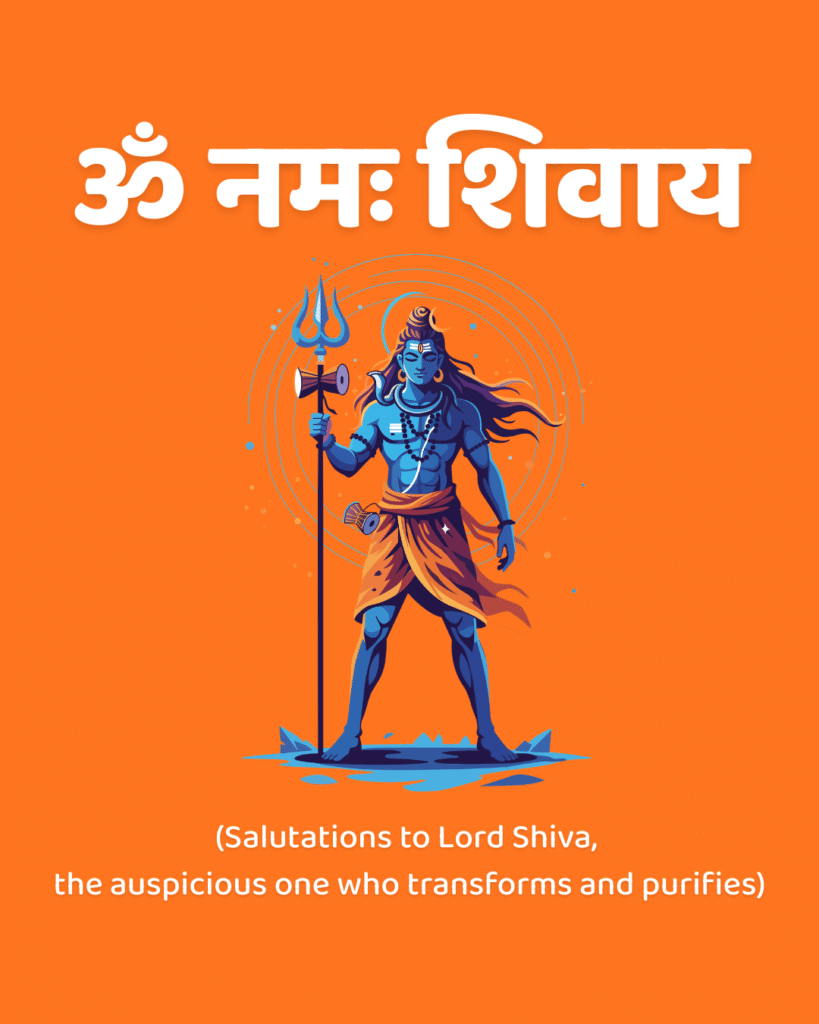
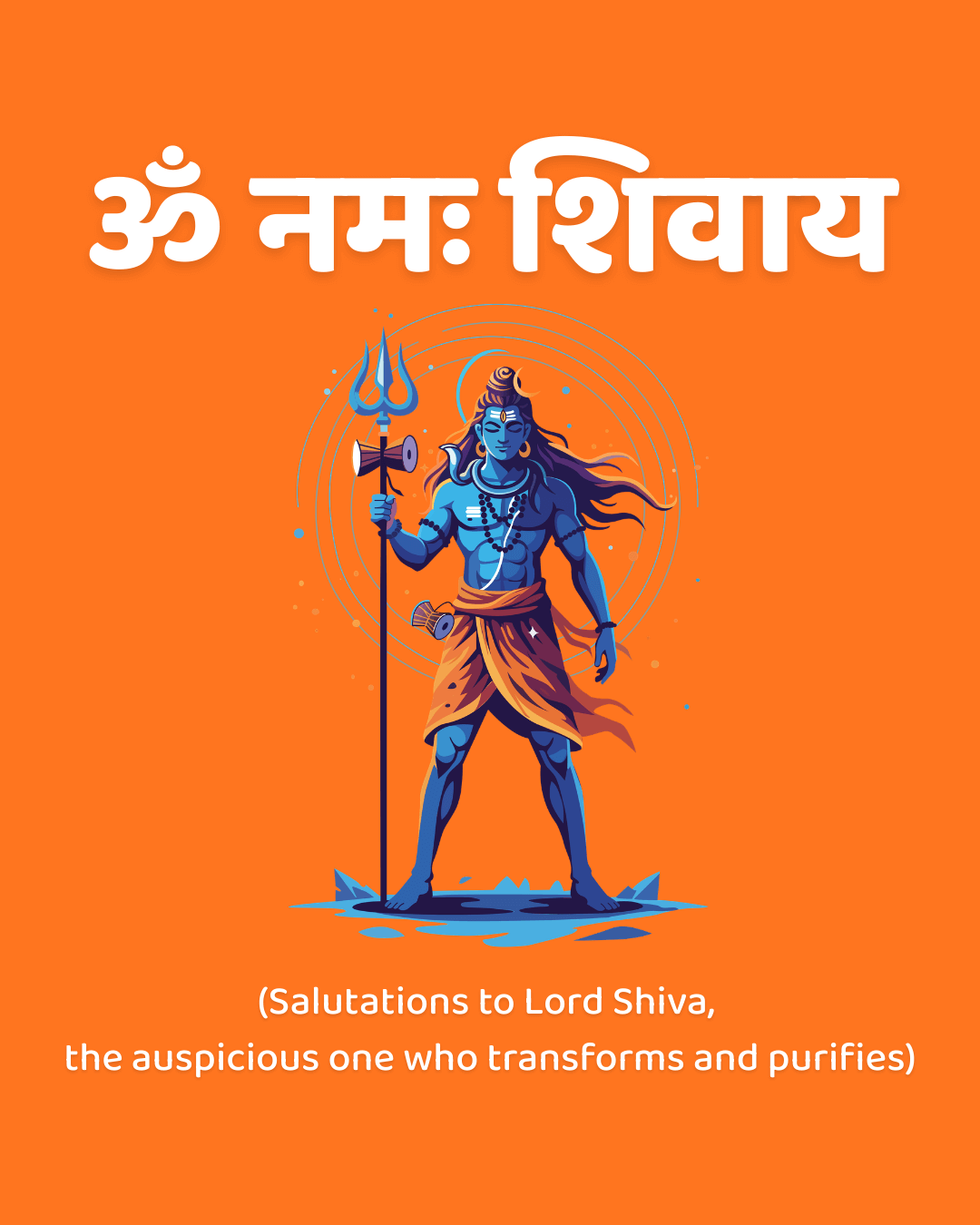
There are five syllables that contain the universe.
Not a description of the universe. Not a map of the universe. The universe itself — every particle of earth, every drop of water, every flame of fire, every breath of air, every expanse of space — compressed, with the precise economy of the divine, into five sounds that any human throat can produce, that any human heart can carry, that any human being in any circumstance of life can offer to the one who made everything.
Na. Ma. Shi. Va. Ya.
Together — ॐ नमः शिवाय. Om Namah Shivay.
The Panchakshari mantra. The five-syllable mantra. The mantra that the Shiva Purana calls the most beloved of all mantras to Mahadev himself. The mantra that saints have chanted in temples and dying people have whispered on their last breath and children have learned before they learned to read and sages have held in their hearts across the entirety of their long, searching, devoted lives.
And the story of how this mantra came to humanity — from the Shiva Purana, Shiva Dharma Samhita and the Mahabharata, Anushasana Parva — begins not in a celestial realm or a cosmic drama but in a very small, very poor, very ordinary home. With a child who was hungry. And a mother who had nothing to give him.
The Meaning of Om Namah Shivay
Before the story — the meaning. Because the meaning is not what most people think it is.
Om — the primordial sound, the cosmic vibration from which the entire manifest universe arose. Not a word. The sound that was before words. The sound that contains all sounds, all languages, all expression, all silence. The Mandukya Upanishad identifies Om as Brahman itself — the absolute, the ground of all being. When Om precedes the Panchakshari, it places the five syllables in the largest possible context — not merely a mantra offered by a human being to a deity but the primordial sound recognising itself in the five-fold expression of its own divine nature.
Namah — salutation, I bow, I honour. But the Sanskrit carries something much deeper than a gesture of respect. Namah breaks down as na + mama — not mine. So Namah is the most complete possible act of surrender. Not merely a bow of the head or a folding of the hands. A statement — I release my claim. I release my sense of ownership over my life, my plans, my fears, my attachments, my outcomes, my identity. All of it — na mama — not mine. All of it returned to its source.
Shivay — to Shiva. The dative form — given toward, offered to, directed at. Shiva — the auspicious one, the one in whom all welfare resides, the one whose nature is grace.
Together — Om Namah Shivay — the primordial sound bowing to Shiva, saying: not mine. Everything I am, everything I think I own, everything I carry — na mama. Yours. I return it all to You.
This is why the Shiva Purana calls Om Namah Shivay the most complete act of surrender available to any human being. Not because the words are powerful in a mechanical sense — not because the vibration automatically produces results regardless of the heart behind it. But because when these five syllables are chanted with true understanding, with the genuine na mama of a heart that has genuinely released its grip — there is nothing left between the devotee and Mahadev. The surrender is complete. The distance dissolves.
The Five Syllables and the Five Elements
Each of the five syllables of the Panchakshari mantra corresponds to one of the five elements — the Pancha Bhuta — from which all of creation is made.
Na — Prithvi — earth. The element of solidity, of the body, of the material world, of all that can be touched and held and measured. When you chant Na, you are returning the earth element — the physical world, the body, all material existence — to its divine source.
Ma — Jal — water. The element of flow, of emotion, of the deep inner tides of feeling that move through every living being. When you chant Ma, you are returning the water element — the emotional world, the capacity to feel, the currents of love and grief and longing — to its divine source.
Shi — Agni — fire. The element of transformation, of heat and light, of the metabolic fire that sustains life and the inner fire of awareness that illuminates experience. When you chant Shi, you are returning the fire element — the transforming, illuminating, life-sustaining force — to its divine source.
Va — Vayu — air. The element of movement, of breath, of the life force that moves through every living body. When you chant Va, you are returning the air element — the breath, the prana, the living movement of every creature — to its divine source.
Ya — Akasha — space. The element of infinite expanse, of the ground in which all other elements exist, of the vast, uncontained, all-containing space that holds the universe. When you chant Ya, you are returning the space element — the infinite ground of all existence — to its divine source.
Five syllables. Five elements. The entire material universe — from the densest particle of earth to the most expansive reach of space — encompassed in a single mantra and returned, in the act of chanting, to the one from whom it all arose.
This is the Panchakshari. This is why the Shiva Purana says that Om Namah Shivay contains the entire universe. Not as a metaphor. As the most precise theological statement possible about what these five sacred syllables are and what they do.
The Story of Upamanyu — From the Shiva Purana
According to accounts in the Shiva Purana, Shiva Dharma Samhita and the Mahabharata, Anushasana Parva — there was a young boy named Upamanyu. He was a Brahmin boy, the son of a sage, but his family was very poor. So poor that there was not always enough to eat. Not the comfortable poverty of those who have enough but sometimes go without — the real poverty of a child who watches other children eat rice and milk and sweets and knows that his mother has nothing in the kitchen to give him.
His mother — with the love that finds a way when there is no way — took white ash. Mixed it with water. Made it into a paste that looked, if you did not taste it, something like milk. And gave it to her son.
Upamanyu ate it.
With faith. With gratitude. With the complete, uncomplicated love of a child for his mother — not knowing, or perhaps knowing and choosing not to show that he knew, that what he was eating was ash and water and her love and her pain, all mixed together.
That night — according to the Shiva Purana — Shiva appeared.
Mahadev. In the form of Indra — the lord of the gods — because Shiva is said to test before he grants, to appear in unexpected forms before he reveals himself in his own. He appeared before Upamanyu and offered him boons. Celestial pleasures. Divine foods. Everything a hungry child might wish for.
Upamanyu refused.
He said — I want nothing from anyone except Shiva himself. I will ask nothing from any other deity. My tapas, my devotion, my hunger — all of it is for Mahadev alone.
Shiva revealed himself.
Stood before the boy in his full divine form — the blue throat, the crescent moon, the Ganga flowing from his matted hair, the trident, the serpent, the third eye — all of it, present, real, the most completely alive divine presence that any human being has ever encountered.
And he asked Upamanyu — what do you want?
The boy said — I want an ocean of milk. So my mother will never again have to make false milk from ash and water. So she will never again have to hide her poverty behind pretence. So she will never have to watch her child eat ash and call it food.
Not for himself. For his mother.
Shiva smiled.
He granted the ocean of milk immediately — the divine abundance that flowed, from that moment, into Upamanyu’s family and never ran dry. The hunger was gone. The poverty was gone. The ash-milk was gone forever.
And then — before leaving, before returning to Kailash, before withdrawing the extraordinary gift of his direct divine presence — Shiva gave the boy something else. Something he had not asked for. Something more precious than any ocean of milk.
He placed five syllables in Upamanyu’s heart.
Na. Ma. Shi. Va. Ya.
He said — chant these always. These five syllables are my most beloved mantra. They contain all five elements. They contain the entire universe. And whoever chants them with a sincere heart will never be truly hungry again. Not for food. Not for love. Not for grace.
This is how Om Namah Shivay came to humanity.
Through a hungry child who ate ash with faith. Through a mother who made love into food. Through the compassion of Mahadev — who did not wait for perfection, who did not require elaborate ceremony or learned scholarship or any qualification except the complete, sincere, unconditional turning of a young heart toward him.
This is the Panchakshari. This is what Om Namah Shivay means. Not merely five sounds. The gift that Shiva placed, with his own hands, in the heart of the boy who refused to ask for anything for himself — and asked only that his mother never have to cry again.
How to Chant Om Namah Shivay
There is no wrong way.
You can chant it loudly in a temple, with a rudraksha mala, 108 times, at the auspicious hours of dawn and dusk. This is beautiful and the tradition honours it completely.
You can chant it silently in your mind while sitting in a bus or a train, while cooking, while working, while walking. Shiva hears mental chanting as clearly as spoken chanting.
You can chant it once, right now, with your whole heart. One sincere Om Namah Shivay reaches Mahadev as completely as a thousand mechanical repetitions.
The great sage Markandeya chanted Om Namah Shivay in the face of death — and Yama himself was stopped in his tracks. The Tamil saint Thirugnana Sambandar chanted it and healings occurred around him. Millions of ordinary devotees across thousands of years have chanted Om Namah Shivay in their most difficult moments and found, in the five syllables, the peace that passes understanding.
Not because the mantra is magic. Because behind the mantra stands Mahadev himself, listening with complete attention and complete love to every single person who calls his name. The way he listened to Upamanyu. The way he has always listened. The way he is listening right now.
The story of Upamanyu and the origin of the Panchakshari mantra is recorded in the Shiva Purana, Shiva Dharma Samhita and the Mahabharata, Anushasana Parva. The correspondence of the five syllables with the five elements is established in the Shiva Purana and the Shaiva Agama tradition.
क्या आप शिव के मंत्र हर वक्त सुनना चाहते हैं? तो MySacredSolutions.in पर विभिन्न sacred games खेलिए — जिन्हें खेलते-खेलते आप शिव मंत्रोच्चार भी कर सकते हैं।
Play Sacred Games — and chant sacred names with every move.
https://mysacredsolutions.in/12-jyotirling-parikrama/?v=2