There is a city on the banks of the Ganga that is unlike any other city on earth. Not because of its temples, though they are magnificent. Not because of its ghats, though they are among the most beautiful human constructions that have ever faced a river. But because of what happens there that nobody can see. What happens there in the private space between a departing soul and the God who is always present at its departure.
That city is Kashi — the city of light. Today it is called Varanasi. And the Shiva who presides over it, who has presided over it since before this universe was made, is Vishwanath. The Lord of the Universe.
The story that opens the heart of Jai Vishwanath comes from a poor weaver — a bhakt so pure and so simple that his story has been told and retold for five hundred years.
His name was Kabir. And Kabir had a problem with Kashi.
The tradition said that anyone who dies in Kashi receives liberation — moksha — directly from Shiva’s lips. Shiva himself whispers the Tarak mantra into the ear of every soul that departs within the boundaries of Kashi, and that whisper liberates them regardless of what they have or have not done in their life. This was the promise of Vishwanath.
But Kabir, that fierce and tender poet-saint, looked at this tradition and said something that startled everyone around him. He said — if Kashi gives liberation just by dying there, what about all the people who cannot reach Kashi? What about the poor souls in the villages and forests and distant mountains who are too sick to travel and too poor to make the journey? Is Vishwanath their lord too — or only the lord of those who can afford the pilgrimage?
Kabir left Kashi. He went to Magahar — a place that had the exact opposite reputation. It was said that anyone who died in Magahar was reborn as a donkey. He went there deliberately. And he died there.
The pandits were confused. The devotees were shocked. Why would a great saint choose the worst possible place to die?
But that night in Kashi, in the inner sanctum of the Vishwanath temple where the jyotirlinga stands, priests performing the midnight aarti reported something extraordinary. They said the flame of the lamp trembled and burned with unusual brightness and from within that brightness they heard, or felt, or understood — Vishwa means every single thing that exists without exception. Nath means lord of all of it without exception.
Vishwanath is not the lord of Kashi alone. He is the lord of Magahar too. He is the lord of every remote village and every distant mountain and every lonely bedside where a soul departs without ceremony. He whispers the Tarak mantra in Kashi because Kashi is where His presence is most concentrated and most visible. But His presence is never absent anywhere. Kabir knew this. That is why Kabir went to Magahar — not in defiance of Vishwanath but in the deepest possible trust that Vishwanath’s lordship has no borders.
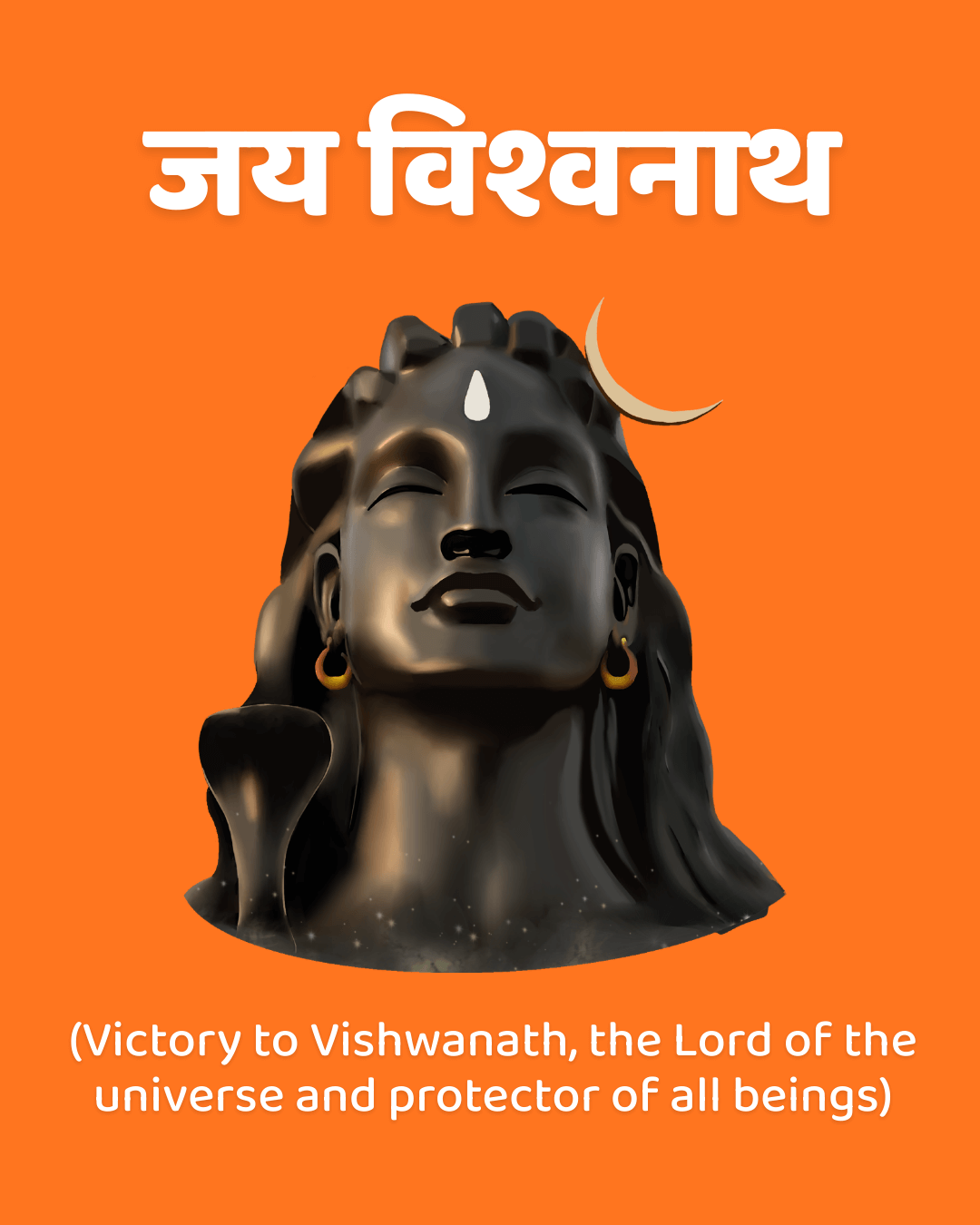
This is Jai Vishwanath.
Vishwa means the entire universe — every atom, every star, every blade of grass, every heartbeat, every moment of joy and grief and confusion and clarity. Nath means the lord and protector of all of it. Vishwanath is the Shiva who is lord not just of the sacred but of the ordinary. Not just of the temple but of the kitchen and the street and the sickroom and the office. Not just of the devoted but of the doubting. Not just of those who have made it to Kashi but of every soul in every corner of every world that has ever existed.
Chant Jai Vishwanath today wherever you are — in your home, in your car, in your office, in a hospital room. Kashi is wherever His presence is. And His presence, as Kabir showed the whole world, has no address that excludes you.
Jai Vishwanath! Har Har Mahadev! 🙏
Do you love listening to Lord Shiva’s chants? We have something special for you. Play a calm and peaceful solitaire game where every move plays a Shiva mantra for you. Explore Om Namah Shivay Solitaire here:
https://www.mysacredsolutions.in/om-namah-shivay-solitaire/