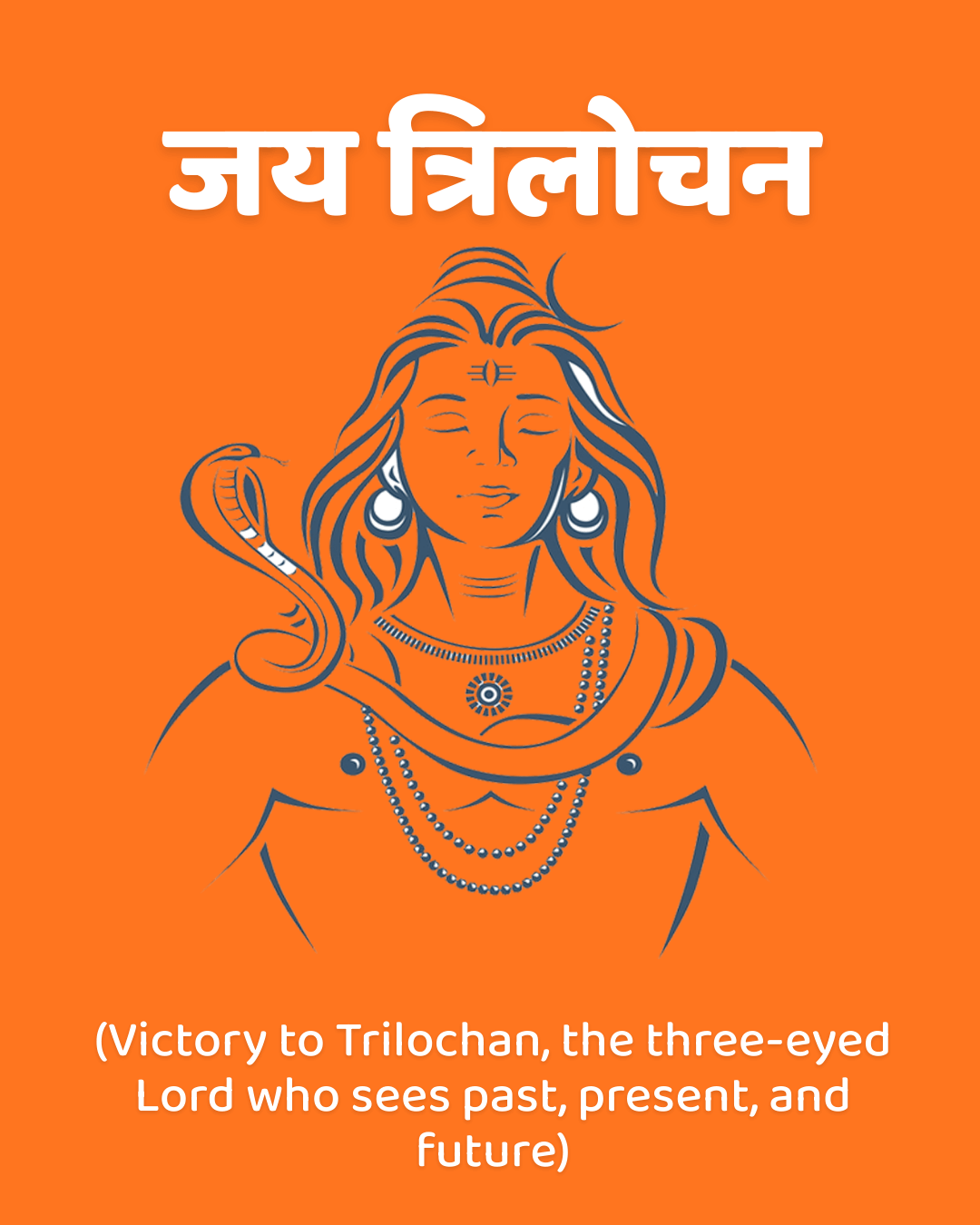
Close your eyes and think of Shiva’s face. Most people, when they do this, find their inner vision travelling almost immediately to one feature above all others. Not the crescent moon. Not the Ganga in His hair. Not the ash on His skin. Their gaze is drawn to the centre of His forehead — to the third eye, that vertical eye of fire that has fascinated and awed the imagination of devotees, artists, philosophers, and seekers for thousands of years.
The third eye of Shiva is perhaps the single most recognised symbol in all of Shaivism. But what does it truly mean? And what is the story behind the moment it first opened?
For that story we must go back to a moment of cosmic crisis — and to a woman’s extraordinary act of love that very nearly ended creation entirely.
Shiva was seated on Kailash in deep meditation. Parvati came to Him from behind in a spirit of divine playfulness and covered His two eyes with Her hands. It was a gesture of love, of closeness, of the easy intimacy between two people who are completely at home with each other. There was no malice in it. There was nothing but affection in it.
But those two eyes were not ordinary eyes. They were the right eye — which is the sun, the source of all light and warmth and life for the entire cosmos. And the left eye — which is the moon, the source of all coolness and moisture and the governing force of every living rhythm on earth. When Parvati’s hands covered them playfully, the sun went dark. The moon went cold. Across the entire cosmos every plant stopped growing. Every river began to slow. Every flame flickered toward extinction. The three worlds lurched toward a darkness that had no name.
Parvati felt this immediately. She felt the universe shuddering beneath her hands. She felt the enormity of what her small playful gesture had accidentally set in motion. She released Shiva’s eyes at once — but for a moment the damage had been done and the cosmos was still trembling.
In that moment — to compensate for the darkness His two eyes had momentarily left — a third eye opened in Shiva’s forehead. Not in anger. Not as a weapon. As light. As the illumination that filled the gap between the sun and the moon when both were briefly extinguished. A fire blazed from that third eye that was not the fire of destruction but the fire of pure knowledge — the light that sees what both the sun and the moon together cannot show, because it is not the light of the outer world but the light of absolute inner truth.
The cosmos steadied. The sun blazed back. The moon returned. And the third eye — having opened for the first time — remained.
This is Trilochan.
Tri means three. Lochan means eye. But the three eyes of Shiva are not three separate windows onto the same world. They see three entirely different dimensions of reality. The right eye sees the physical world — what is happening here and now in the realm of matter and action. The left eye sees the subtle world — what is happening in the realm of feeling, time, rhythm, and the invisible forces that govern life. And the third eye sees what neither of them can see — the truth behind appearance, the reality beneath the surface, the answer to the question that no event in time can ever fully answer on its own: what does this truly mean?
This is why the third eye of Shiva, when it opens fully, is not just a fire of destruction — though it destroyed Kama, though it burned Tripurasura, though it consumes every illusion. It is first and foremost the eye of wisdom. The eye that looks at the full picture. The eye that sees karma and consequence and the deeper purpose working through every event of every life.
When you chant Jai Trilochan you are celebrating this seeing. And you are asking, in the most joyful possible way, for a little of that seeing to be given to you. Open the third eye in my own heart, Trilochan. Not the fire. The light. Let me see what I am not seeing. Let me understand what I am misunderstanding. Let me find the deeper truth in what looks only like difficulty or loss or confusion from the outside.
Because what Parvati’s hands accidentally revealed — that when the outer lights go dark a deeper light can open — is true in every human life too. Our most confusing moments, our darkest periods, are often the precise moments when our own inner third eye has the best chance of opening for the first time.
Chant Jai Trilochan today — to close this magnificent series of forty sacred mantras — with the joy and the gratitude of the devotee who knows they are seen completely, inside and out, by the three eyes of Mahadev. And who would not have it any other way. Har Har Mahadev! 🙏
Do you love listening to Lord Shiva’s chants? We have something special for you. Play a calm and peaceful solitaire game where every move plays a Shiva mantra for you. Explore Om Namah Shivay Solitaire here:
https://www.mysacredsolutions.in/om-namah-shivay-solitaire/