
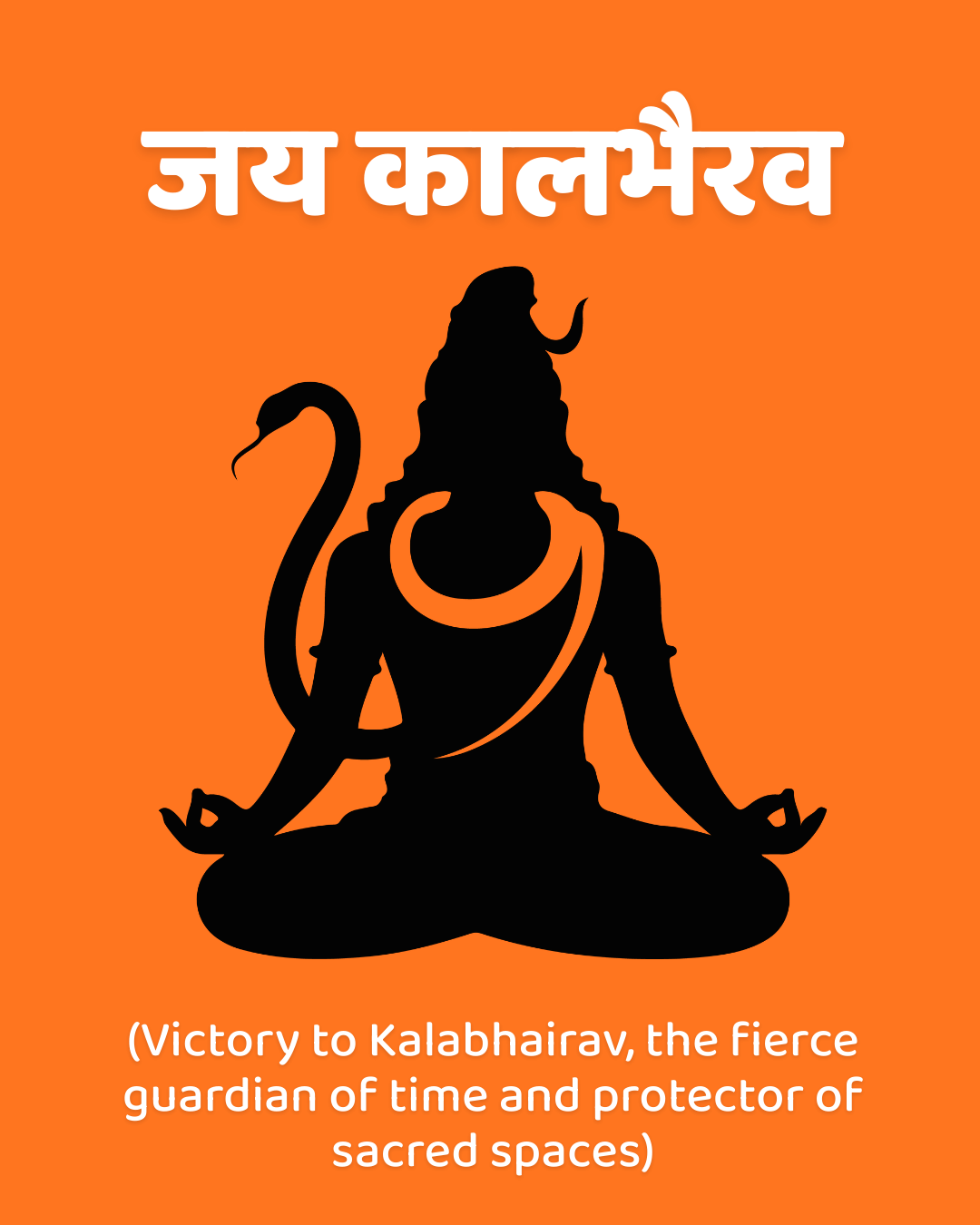
Among all the forms of Shiva there is one that even experienced devotees sometimes approach with a quickened heartbeat and wide eyes. Not because Kaal Bhairav will harm them. But because in His presence something happens that does not happen before any other form of the divine. Every pretence falls away. Every comfortable story about yourself quietly collapses. Every fear you have been carefully managing from a safe distance suddenly stands directly in front of you with nowhere left to hide.
And then something extraordinary happens. When the fear stands fully revealed and fully present — it dissolves.
This is the gift of Kaal Bhairav. And to understand it properly you need to know the story of how this most extraordinary form of Shiva came into existence.
It begins with an argument between Brahma and Vishnu — two of the greatest beings in creation — about who among them was the supreme god. This argument had gone on for a long time and had grown from a philosophical disagreement into something considerably less dignified. Brahma, in a moment of pride that was entirely unworthy of his greatness, said something that crossed a line that should never have been crossed. He made a disrespectful claim about Shiva — about the very lord whose absolute supremacy is beyond all comparison and all question.
The moment those words left Brahma’s fifth head — the head that had always been the seat of his greatest pride and his greatest arrogance — something appeared. It did not walk in from somewhere else. It erupted from within Shiva’s own being like a truth that could no longer remain contained. A form of terrifying aspect — dark as the deepest night, blazing with an energy that made the three worlds tremble, carrying a staff and a skull bowl, accompanied by dogs who are the companions of those who dwell beyond all boundaries of the ordinary world.
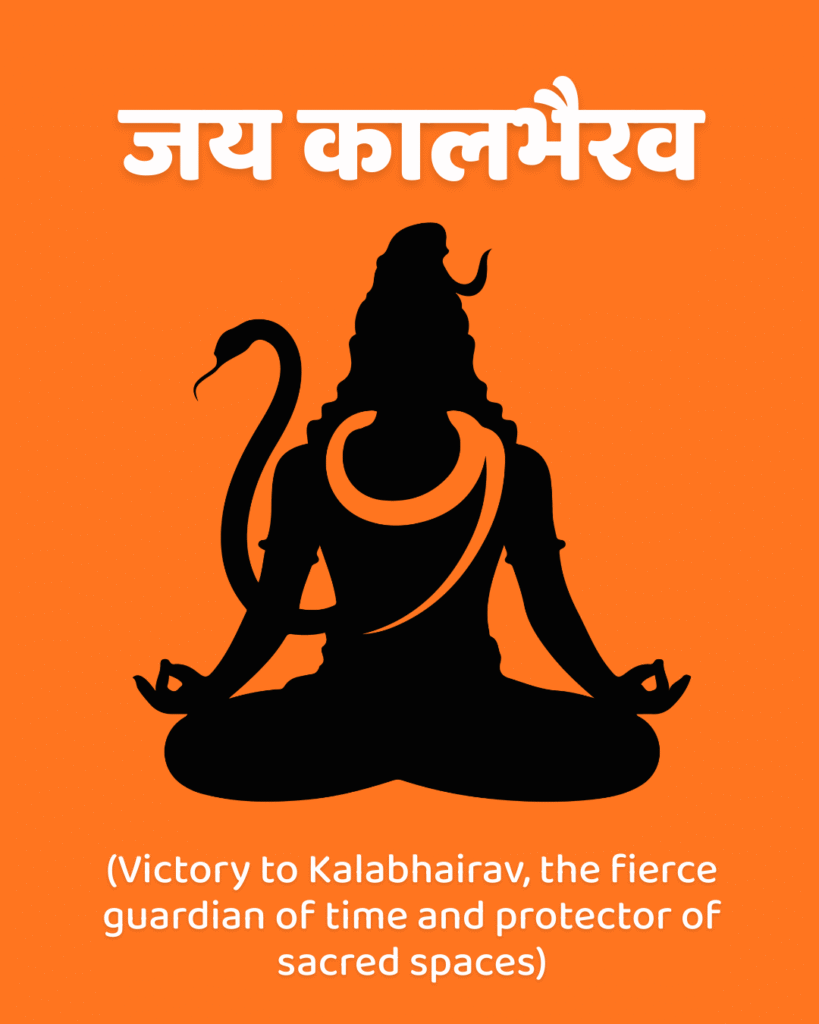
This was Kaal Bhairav.
And He was looking directly at Brahma’s fifth head.
Before anyone could speak or intervene, that head — the head of arrogance, the head that had spoken what should never have been spoken — was gone. Kaal Bhairav had removed it in a single motion.
The assembly fell into absolute silence. Even the greatest gods sat motionless.
Then something equally extraordinary happened. Kaal Bhairav stood with the skull of Brahma’s fifth head in His hand — and wept. Not from regret. From the weight of what He carried. Because what Bhairav had done was not an act of anger. It was a surgical act of compassion. He had removed the specific source of a great being’s bondage — the ego-pride that was the one thing standing between Brahma and his own full liberation.
And now Kaal Bhairav would carry that skull forever — the Brahmakapala — as a reminder. He wandered through the three worlds as a renunciant carrying the skull, and that wandering became a teaching. He went to Kashi — the city of liberation — and there the skull finally fell from His hand at the spot that became one of the most sacred sites in the city.
This is Kaal. This is Bhairav. Kaal means time — the great destroyer that consumes all things without exception, from which nothing in the manifest universe can escape. Bhairav means the terrifying, the one who causes fear in the small sense of self, the one whose presence dissolves all the comfortable illusions by which the ego sustains itself. Kaal Bhairav is therefore the form of Shiva that destroys the one thing that time and fear are always pointing toward — the false self, the ego-structure that mistakes itself for what you truly are.
When you stand before Kaal Bhairav you cannot pretend. And that inability to pretend is the greatest mercy He offers. Because the moment pretence falls away and you stand in His presence as you actually are — frightened, confused, imperfect, completely human — He has nothing left to destroy. What He destroys is only the pretence. What remains after the pretence falls is you. The real you. Which has nothing to fear.
Jai Kaal Bhairav is therefore one of the most liberating chants in this entire series. It is not chanted by people who are comfortable. It is chanted by people who have decided to stop being comfortable with their own pretences. It is the chant of the devotee who says — I am tired of managing my fears from a distance. I am bringing them directly to the one who is larger than all of them.
Chant Jai Kaal Bhairav today with courage — not the courage that feels no fear, but the courage that walks directly toward what it fears and discovers that Shiva was standing there all along. Har Har Mahadev! 🙏
Do you love listening to Lord Shiva’s chants? We have something special for you. Play a calm and peaceful solitaire game where every move plays a Shiva mantra for you. Explore Om Namah Shivay Solitaire here:
https://www.mysacredsolutions.in/om-namah-shivay-solitaire/