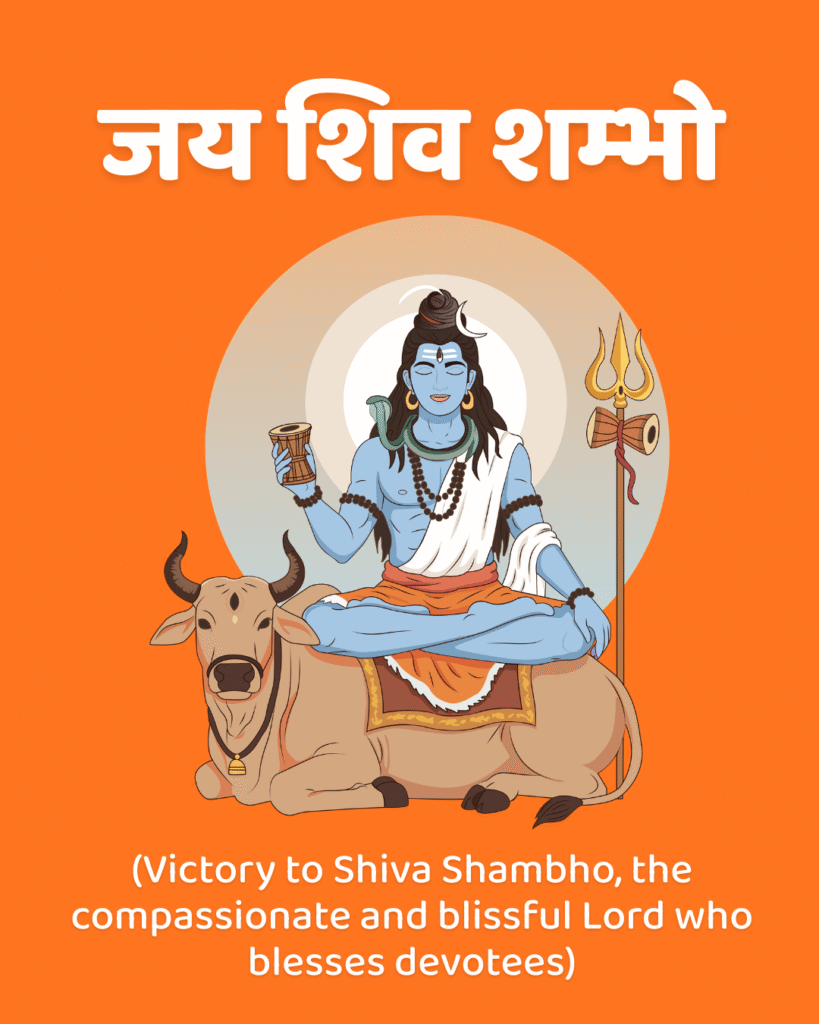
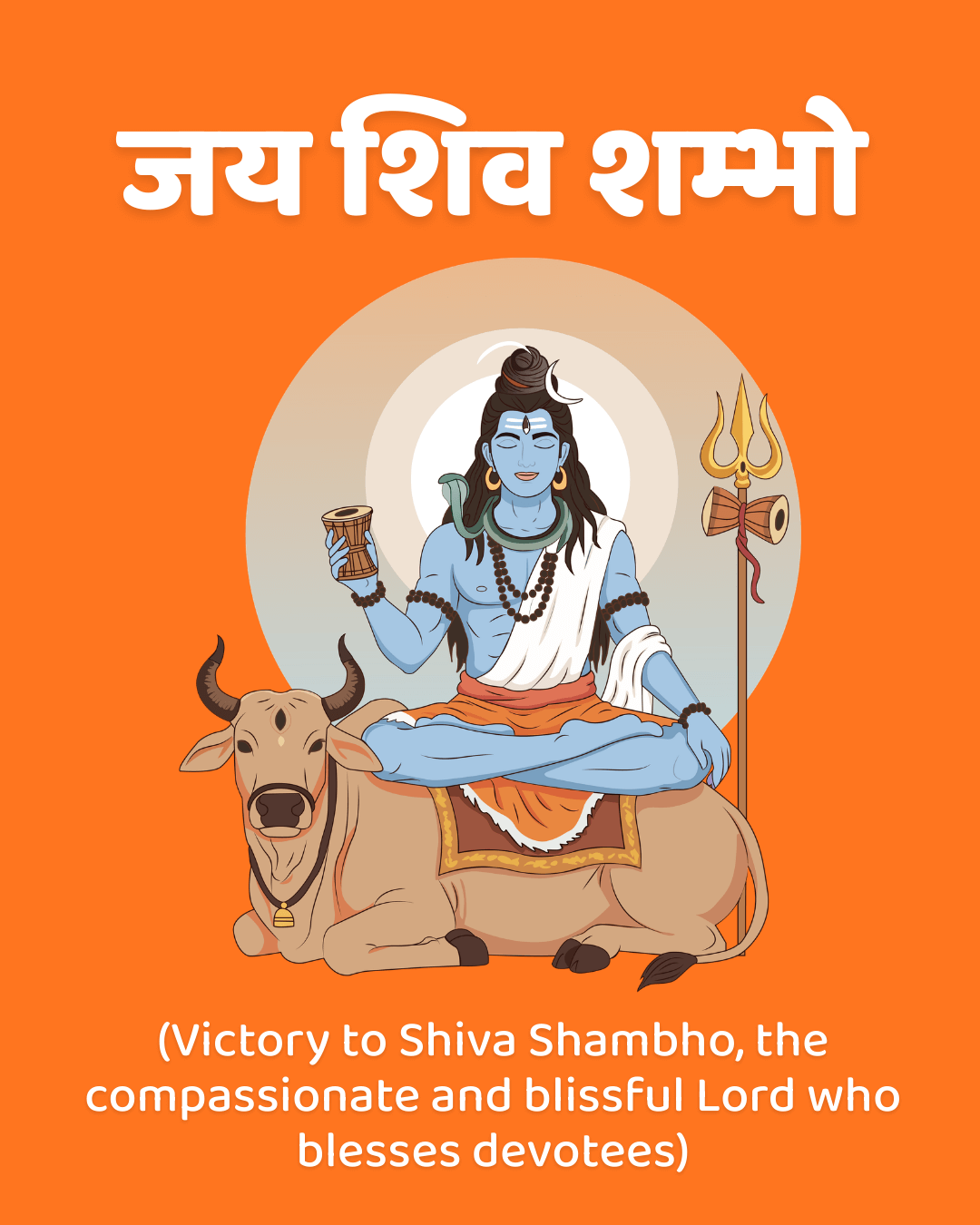
Among all the names of Shiva there is one that carries a feeling different from all the others. Not the fierce power of Rudra. Not the supreme authority of Parameshwara. Not even the tender love of Bholenath. Shambho carries something those other names do not quite carry on their own. It carries the feeling of light. Of warmth. Of a joy so natural and so deep that it does not need a reason.
Shambho. Say it out loud right now. Feel how the sound itself seems to open something in the chest. Sham — a sound of peace and settling. Bho — a sound of blossoming and opening. Even the sound of this name is a small doorway into what it means.
In Sanskrit Shambhu or Shambho comes from the root sham — meaning auspicious, peaceful, blissful — combined with bhu — meaning the one who is, the one who exists, the source. Shambho is therefore the one whose very existence is bliss. Not the one who sometimes feels joy or sometimes bestows joy. The one who is made of joy the way the sun is made of light. The one for whom bliss is not an experience that comes and goes but the fundamental nature of what He is.
The Story of the Old Musician Who Found What He Had Always Been Playing Toward
There was once an old musician named Madhavdas who had spent his entire life playing the veena in the villages and temples of Rajasthan. He was not famous. He had never played in grand courts or before great assemblies. He played at small village festivals, at the weddings of ordinary families, at the corner shrines of small towns where a single lamp burned before a simple Shivalingam and no priests were present.
People loved to hear him play. They could not always say why. His music was technically correct but not extraordinary. He had no special training, no famous guru, no great lineage. What his music had was something else entirely — a quality of stillness inside the sound that made listeners feel, without being able to explain it, that something larger than the melody was present in the room.
Madhavdas himself did not know what this was. He only knew that when he played with his full attention, something happened that was not entirely his own doing. The music would arrive from somewhere and move through his hands. He would begin to play and then at a certain point he would feel himself step back — not physically, but inwardly — and the music would continue without him. He called this the gap. He had felt the gap for forty years. He had never been able to explain it to anyone.
One evening in the last years of his life he was playing at the small Shiva temple in a village near Jodhpur. It was Shivaratri. The lamps were lit. The air smelled of dhoop and marigold. The families had gone home. Only one old priest remained, finishing the final aarti of the night with quiet concentration.
Madhavdas was sitting in the corner of the courtyard still holding his veena. The aarti ended. The priest turned and looked at the old musician. He said — you play Shambho’s music.
Madhavdas was startled. He said — I just play what comes. I do not know whose music it is.
The priest smiled. He said — that is exactly what I mean. Shambho is the name of Shiva that means the one whose very nature is bliss. Not a bliss that comes and goes. A bliss that simply is — the way the sky simply is, the way deep water simply is. When you step back inside your music and let it come through rather than pushing it — that is Shambho. That is His nature moving through yours. The gap you feel is the gap between your small self and the bliss that is always underneath it. Shambho is that bliss. And you have been touching it with every sincere note you have ever played.
Madhavdas sat very still for a long time. Then he picked up his veena and played one more time, very softly, just for himself. And this time he knew the name of what was moving through his hands.
He played Shambho’s music until the last lamp went out.
This is the heart of Jai Shiv Shambho.
The chant of the devotee who has recognised that the unexplained peace, the sudden warmth, the joy that arrives without reason in the middle of an ordinary moment — these are not accidents. They are Shambho. They are Shiva’s bliss nature touching your life, spilling over from His infinite fullness into your small cup, simply because that is what light does. It illuminates whatever is nearby. It cannot help it. It is its nature.
The gap that Madhavdas felt — that inward stepping-back when something larger than yourself moves through you — every devotee knows this gap in some form. It happens in prayer. It happens in deep listening. It happens in those rare moments of pure presence when the self becomes quiet enough for Shambho to be felt directly.
When you chant Jai Shiv Shambho today, chant it in gratitude for every moment of unexplained peace you have ever received. For every sunrise that was more beautiful than you needed it to be. For every sudden stillness in the middle of a difficult day. For every time music moved through you rather than just from you. That was Shambho. That has always been Shambho. And He is doing it again right now.
Jai Shiv Shambho! Har Har Mahadev! 🙏
Do you love listening to Lord Shiva’s chants? We have something special for you. Play a calm and peaceful solitaire game where every move plays a Shiva mantra for you. Explore Om Namah Shivay Solitaire here:
https://www.mysacredsolutions.in/om-namah-shivay-solitaire/